ROCLING 2026 Shared Task

Chinese Dimensional Sentiment Analysis for New Immigrants' Feeling Texts
(DSA-NIFT)

Organizers

林孜彌 Tzu-Mi Lin

劉雯妮 Wen-Ni Liu

李龍豪 Lung-Hao Lee

國立陽明交通大學 智能系統所
Institute of Artificial Intelligence Innovation
National Yang Ming Chiao Tung University

湯晏甄 Yen-Chen Tang

國立東華大學 公共行政學系
Department of Public Administration
National Dong Hwa University


Contact:

Discord: https://discord.gg/bCDPAzNn7

Registration

Background

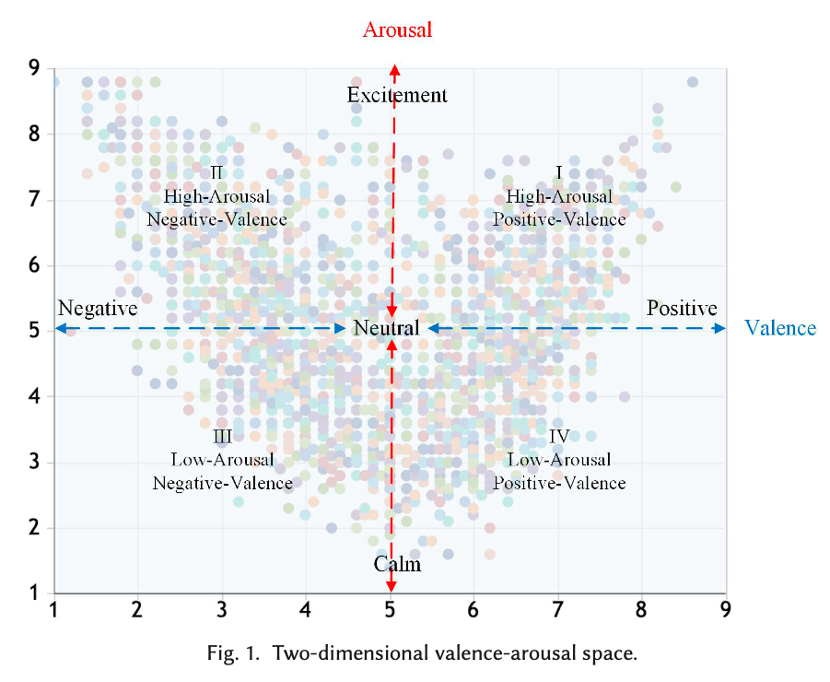
Sentiment analysis has emerged as a leading technique to automatically identify affective information within texts. In sentiment analysis, affective states are generally represented using either categorical or dimensional approaches (Calvo and Kim, 2013). The categorical approach represents affective states as several discrete classes (e.g., positive, negative, neutral), while the dimensional approach represents affective states as continuous numerical values on multiple dimensions, such as valence-arousal (VA) space (Russell, 1980), as shown in Fig. 1. The valence represents the degree of pleasant and unpleasant (or positive and negative) feelings, and the arousal represents the degree of excitement and calm. Based on this two-dimensional representation, any affective state can be represented as a point in the VA coordinate plane by determining the degrees of valence and arousal of given words (Wei et al., 2011; Malandrakis et al., 2013; Wang et al., 2016; Du and Zhang, 2016; Wu et la., 2017; Yu et al., 2020; Deng et al., 2022) or texts (Kim et al., 2010; Paltoglou et al, 2013; Goel et la., 2017; Zhu et al., 2019; Wang et al., 2019; 2020; Deng et al., 2023; Lin et al., 2024).

The first dimensional sentiment analysis (DSA) task for Chinese words (Yu et al., 20216) was organized at the IALP 2016 conference. The second edition of DSA task was organized at the IJCNLP 2017 conference to include both Chinese words and phrases (Yu et al., 2017). The third edition was organized at the ROCLING 2021 conference to explore the sentence-level dimensional sentiment analysis task on educational texts (students’ self-evaluated comments) (Yu et al., 2021). The fourth edition of DSA task was orginized at the ROCLING 2025 conferenceto to analyze medical multi-sentence texts (Lee et al., 2025). This year, we organize the fifth edition of the DSA shared task, which focuses on dimensional sentiment prediction for texts reflecting the feelings, daily experiences, and psychological states of new immigrants.
VA Chart

Figure 1: Valence-Arousal Space

Task Description

Dimensional sentiment analysis is an effective technique to recognize the valence-arousal ratings from texts, indicating the degree from most negative to most positive for valence, and from most calm to most excited for arousal. In this task, participants are asked to provide a real-valued score from 1 to 9 for both valence and arousal dimensions for each new immigrants' reflection texts. The input format is “ID, texts”, and the output format is “ID, vallence_rating, arousal_rating”. Below are the input/output formats of the example sentences.

EXAMPLE 1

Input: ex01, 我時常祈禱或找其他事情做,這樣我就可以忘記我的問題。
Output: ex01, 4.375, 5.0

EXAMPLE 2

Input: ex02, 我目前的心情很好,只是有時候會想念在印尼的家人
Output: ex02, 6.0, 5.75

Data

Training Set: Chinese EmoBank (Lee et al., 2022)

The Chinese EmoBank (Lee et al., 2022) is a dimensional sentiment resource annotated with real-valued scores for both valence and arousal dimensions. The valence represents the degree of positive and negative sentiment, and arousal represents the degree of calm and excitement. Both dimensions range from 1 (highly negative or calm) to 9 (highly positive or excited). The Chinese EmoBank features various levels of text granularity including two lexicons called Chinese valence-arousal words (CVAW, 5,512 single words) and Chinese valence-arousal phrases (CVAP, 2,998 multi-word phrases) and two corpora called Chinese valence-arousal sentences (CVAS, 2,582 single sentences) and Chinese valence-arousal texts (CVAT, 2,969 multi-sentence texts).


Validation Set

There are 200 new immigrants' feeling texts for system development.

Test Set

We will provide 1,100 new immigrants' feeling texts for system performance evaluation.

Evaluation

The performance is evaluated by examining the difference between machine-predicted ratings and human-annotated ratings (valence and arousal are treated independently). The evaluation metrics include: Mean Absolute Error (MAE) and Pearson Correlation Coefficient (PCC) , defined as follows

$$ MAE = \frac{1}{n} \sum_{i=1}^{n}|a_{i}-p_{i}| $$ $$ PCC = \frac{1}{n-1} \sum_{i=1}^{n}(\frac{a_{i}-\mu_{A}}{\sigma_{A}})(\frac{p_{i}-\mu_{P}}{\sigma_{P}})$$

where \( a_{i}\in{A} \) and \( p_{i}\in{P} \) respectively denote the i-th actual value and predicted value, n is the number of test samples, and \( \mu_{A} \) and \( \sigma_{A} \) respectively represent the mean value and the standard deviation of A, while \( \mu_{P} \) and \( \sigma_{P} \) respectively represent the mean value and the standard deviation of P.

The actual and predicted real values range from 1 to 9, so MAE measures the error rate in a range where the lowest value is 0 and the highest value is 8. A lower MAE indicates more accurate prediction performance. The PCC is a value between −1 and 1 that measures the linear correlation between the actual value and the predicated value. A lower MAE and a higher PCC indicate more accurate prediction performance. Each metric for the valence and arousal dimensions is ranked independently.A model’s overall ranking is computed based on the mean rank across the four metrics. The lower the mean rank, the better the system performance.

Important Dates

ScheduleDate
Release of test dataJuly 15, 2026
Testing results submission dueJuly 17, 2026
Release of evaluation resultsJuly 20, 2026
System description paper dueAugust 10, 2026
Notification of AcceptanceSeptember 18, 2026
Camera-ready deadlineOctober 5, 2026

References